Two nights, predicted pace. Open a night when a stop or a name catches you.
| Night | Astro dusk | Astro dawn | Length | Optimistic km | Realistic km | Conservative km |
|---|---|---|---|---|---|---|
| 1 | Fri 18 Sep 19:19 | Sat 19 Sep 04:37 | 9h 18m | 67–109 | 60–99 | 53–89 |
| 2 | Sat 19 Sep 19:18 | Sun 20 Sep 04:37 | 9h 19m | 157–157 | 152–157 | 136–157 |
Twilight (context)
| Event | Local time | Elapsed |
|---|---|---|
| sunset | Fri 18 Sep 18:04 | 10h 05m |
| civil dusk | Fri 18 Sep 18:27 | 10h 27m |
| nautical dusk | Fri 18 Sep 18:53 | 10h 53m |
| astronomical dusk | Fri 18 Sep 19:19 | 11h 20m |
| astronomical dawn | Sat 19 Sep 04:37 | 20h 37m |
| nautical dawn | Sat 19 Sep 05:03 | 21h 04m |
| civil dawn | Sat 19 Sep 05:29 | 21h 30m |
| sunrise | Sat 19 Sep 05:52 | 21h 52m |
| sunset | Sat 19 Sep 18:03 | 34h 04m |
| civil dusk | Sat 19 Sep 18:26 | 34h 26m |
| nautical dusk | Sat 19 Sep 18:52 | 34h 52m |
| astronomical dusk | Sat 19 Sep 19:18 | 35h 19m |
| astronomical dawn | Sun 20 Sep 04:37 | 44h 38m |
| nautical dawn | Sun 20 Sep 05:04 | 45h 04m |
| civil dawn | Sun 20 Sep 05:30 | 45h 30m |
| sunrise | Sun 20 Sep 05:52 | 45h 52m |
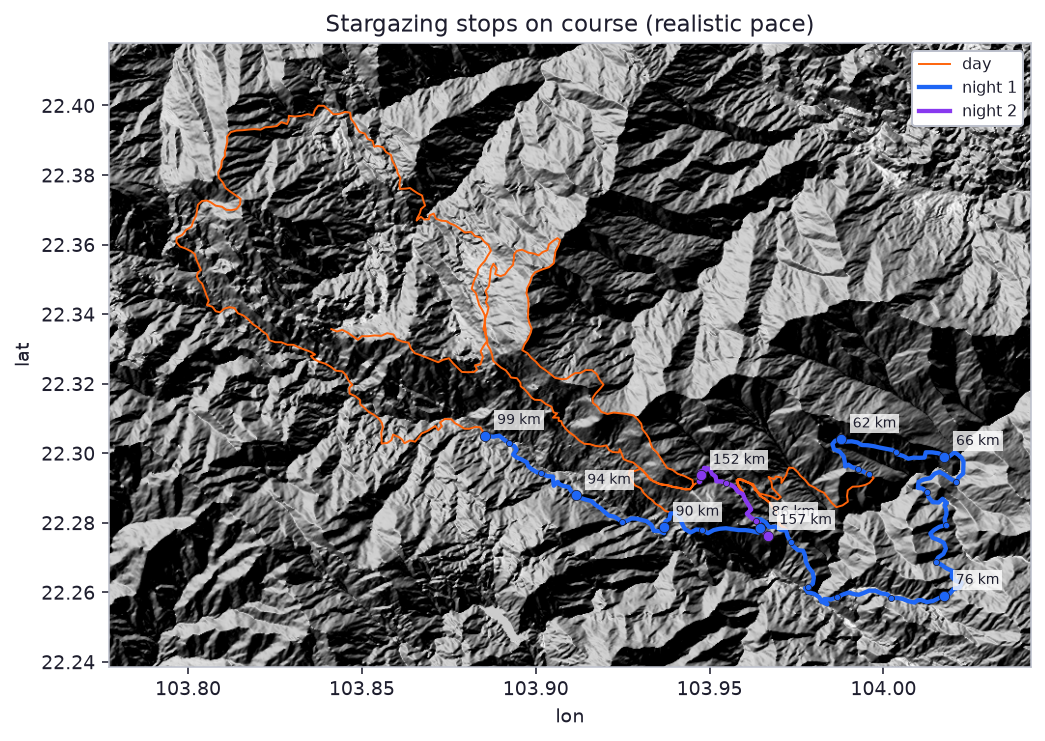
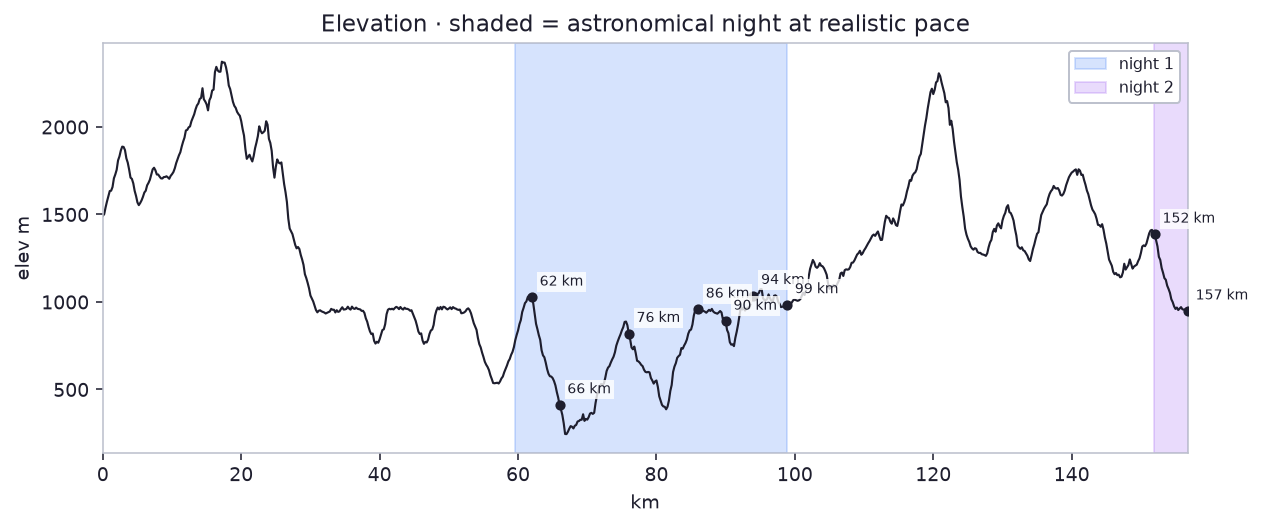
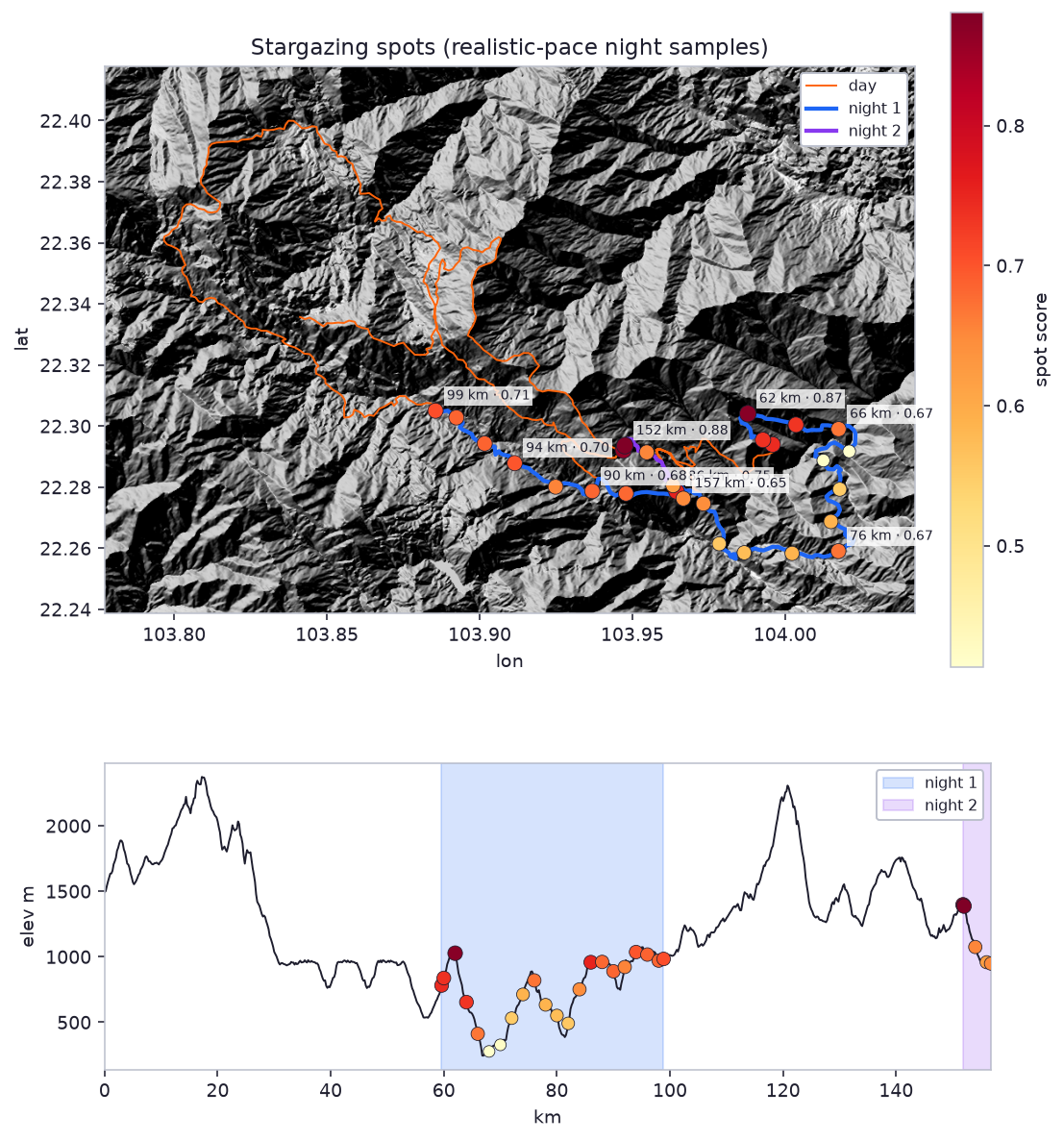
While the course is astronomically dark, it is sampled every 2 km. Each point is scored for an open DSM horizon, higher ground, a dim or set moon, and whether the Milky Way centre sits above the local horizon. Aid stations are not used. The listed places are the highest-scoring points, spaced along the course so closer samples are the same stretch, not extra stops.